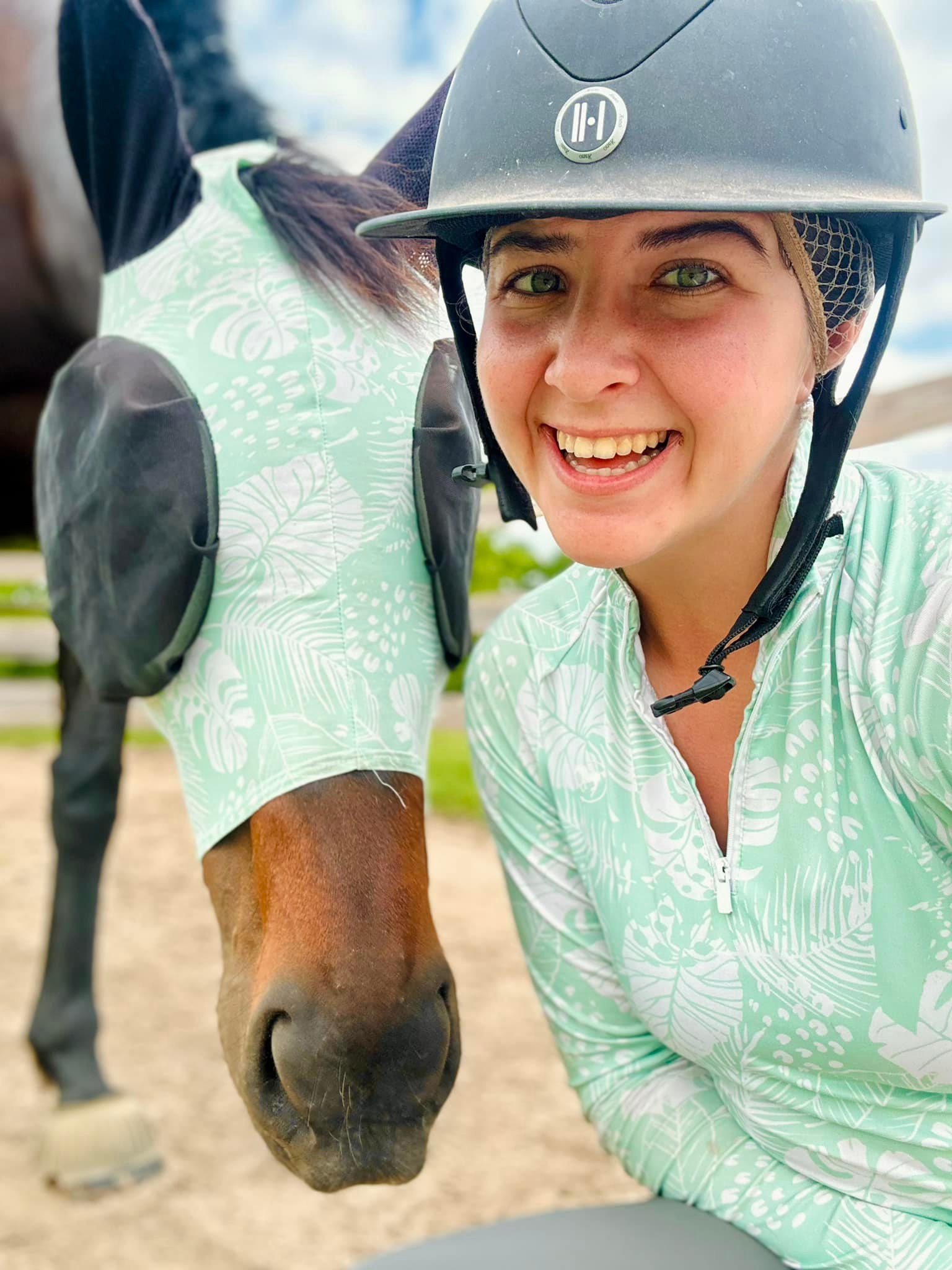
Watch a rider on a hot horse just before she asks for anything: a downward transition, a half-halt, the turn toward the scary end of the arena. Her chest lifts. Her shoulders creep up. For one or two strides, she stops breathing. Then the horse scoots, and she concludes he’s just hot.
Sometimes he is. But often the horse is reacting to the breath you just held. If he gets quicker every time you try to slow him down, look at your breathing before you look at your hands.
What a Held Breath Feels Like From His Back
Holding your breath is more than a mental habit. It changes how your body works.
Your diaphragm attaches to the lumbar spine. When you breathe normally, it moves down and up, and your lower back and pelvis stay a little bit mobile, enough to follow the swing of the horse’s back. When you hold your breath, the diaphragm locks. Pressure inside your trunk goes up, your lower back stiffens, your hip flexors grab, and your seat stops following. For those strides, you are a solid object sitting on a moving animal.
A quiet horse will often put up with that. A hot horse reads it as information, and the message is alarm. Think of a herd: the horse who suddenly goes still and tight is the one who just saw something. When your body does the same thing on his back, he can’t tell that you were only getting ready for a half-halt. He feels the brace and gets ready to leave.
Sally Swift asked this in Centered Riding: what would you think if your horse held his breath? Cathy Woods brought that question up when she talked about breath work on the podcast. Her point was that breath is tied directly to emotion. When we’re startled or nervous, we suck in air or breathe shallowly, and our horses feel it. You would notice right away if your horse stopped breathing underneath you. He notices when you do it too.
The Loop That Makes Hot Horses Hotter
The pattern usually goes like this:
- The horse gets a little quick.
- You hold your breath and brace to half-halt.
- Your seat locks and your hands get firmer, because a held breath tightens your arms as well.
- He feels the brace as a threat and the hand as a trap, so he gets quicker.
- You hold your breath again, a bit longer this time.
Gabi Neurohr described the rein side of this when she was on the show. A short, restrictive contact feels claustrophobic to a horse who is already worried. For a flight animal, losing the freedom to move is exactly what makes him feel vulnerable, and things snowball from there. She sees nervous riders shorten the reins on a young or looky horse and then wonder why he rushes, shakes his head, and gets harder to stop. Her answer runs against instinct: allow the forward, and the control problems often disappear.
The breath-hold comes before the short rein. If you stop holding your breath, a lot of the grabbing stops on its own.
Hot horses aren’t all the same, though. Some really are full of energy and need a job. Others are anxious and running on adrenaline. If you can’t tell which one you’re sitting on, start with how to tell energy from anxiety in a hot horse, because the breath work below helps both but matters far more for the anxious one.
Find Your Hold First
You can’t fix a breath-hold you don’t know you’re doing, and most riders don’t know. Spend one ride just noticing. The usual moments are:
- The stride before a downward transition.
- Every half-halt. This is the most common one.
- Approaching the corner where he spooked last week.
- The moment his head comes up or he snorts at something.
- Picking up canter, especially on a horse who has bolted into it before.
Here’s an easy test: hum, talk, or count out loud. You can’t hum while holding your breath. If the humming stops, you’ve found your hold. Some riders who think they breathe fine find that they go quiet every time they close their fingers.
Ride the Half-Halt on the Exhale
This is the main change, and it takes the most practice.
Most riders breathe in to prepare for a half-halt. They lift the chest, gather themselves, and hold. Do the opposite. The half-halt happens on the out-breath.
When you exhale slowly through pursed lips or with a soft “sss,” a few things happen. Your diaphragm releases, your seat gets heavier and keeps moving with the horse, and your deep abdominals engage from the bottom up instead of bracing from the top down. The horse feels you get more organized without getting more rigid. That is the half-halt you were trying to give in the first place.
The sequence:
- Inhale for a stride or two, normally. Don’t make a big breath of it.
- Exhale slowly, and close your fingers and let your weight sink into your seat bones during the exhale.
- Soften at the end of the exhale. Hands go back to neutral and your seat keeps following.
- Repeat as needed. Give several small exhale half-halts rather than one long held one.
If he’s the kind of horse who runs away from your leg the moment you put it on, then gets quick, then gets quicker when you try to half-halt, the “Hot Horse Warm-Up” ride-along walks you through it in the saddle. It covers shoulder-in at the walk, leg yields, half-halts that actually work, and posting into the canter so he can’t jolt away from you. It’s free and about fourteen minutes. Play it during your next warm-up and practice exhaling on every half-halt it asks for.
Give Your Breath a Rhythm
A hot horse often loses his rhythm before he loses his brain. You can lend him yours.
- Walk: inhale for four steps, exhale for four. If that’s too long, use three. Keep the out-breath at least as long as the in-breath.
- Rising trot: inhale for two posts, exhale for two or three. Counting out loud is fine and helps.
- Canter: match your breath to the stride, with something short and steady on each jump. Horses at canter and gallop naturally breathe in time with their stride. A rider who breathes in rhythm fits into that. A rider who holds her breath interrupts it.
This isn’t meant to make you look serene. It gives your body a metronome so the brace has no gap to slip into. If you’re in a rhythm, you aren’t holding.
Wait for His Breath, Too
In groundwork and on hacks, I don’t count licking and chewing as the release I’m looking for. Some horses figure out that a lick-and-chew gets them a cookie, and they’ll do it on cue. What I wait for is a breath: a real exhale, a sigh, a soft snort. That’s the horse letting go of whatever worry he was holding. I may reward a lick or two along the way, but I don’t move on until he has breathed.
Do the same under saddle. After your horse settles from a quick moment, halt or walk on a longer rein and wait. Don’t start the next exercise until he exhales. You’re training two nervous systems at once, and the habit you’re building in both of you is the same: something worrying happens, then you breathe, then you go on.
Learn his warning signs, too. A horse who suddenly starts tripping or reaching for grass or branches on a hack when he wasn’t doing that earlier is often telling you his nervous system just went up a gear. That’s when you’re most likely to hold your breath, so use that sign as your cue to exhale.
For more on what your body can do when the reins aren’t the answer, see co-regulating with a hot horse through your body instead of your hands.
Practice When It Doesn’t Matter
Here’s why “just breathe” doesn’t work in the moment: under real stress, you do what you’ve practiced, not what you meant to do.
Cathy Woods made this point too. Breath work has to be trained when things are calm so it’s available when they aren’t. It doesn’t take long sessions. You can practice in the car, in the grocery line, or while you groom. And as she put it, “Practice makes permanence.”
So do the exhale half-halt on your quiet horse. Do it at the walk on a loose rein on a cold November morning when nothing is going on. Use Sam’s ride-alongs as audio lessons you can play while you ride and practice on your own between lessons. By the time your hot horse lifts his head at the far end, the exhale should already be your habit.
You don’t have to feel calm to do this. You can be scared and still breathe out. That’s a skill you can train, and holding the fear and the forward motion at the same time is most of what confidence on a hot horse actually is.
If your horse gets hotter the harder you try to slow him down, I’d like to see you ride him. Most of the time the fix is somewhere you haven’t looked yet: your breath, your seat, or the timing of your aid. I teach lessons and run clinics out of Aiken, SC, and travel for clinics around the region. We’ll find where you’re holding and build a half-halt your horse can actually trust. Reach out here to book a clinic or lesson.