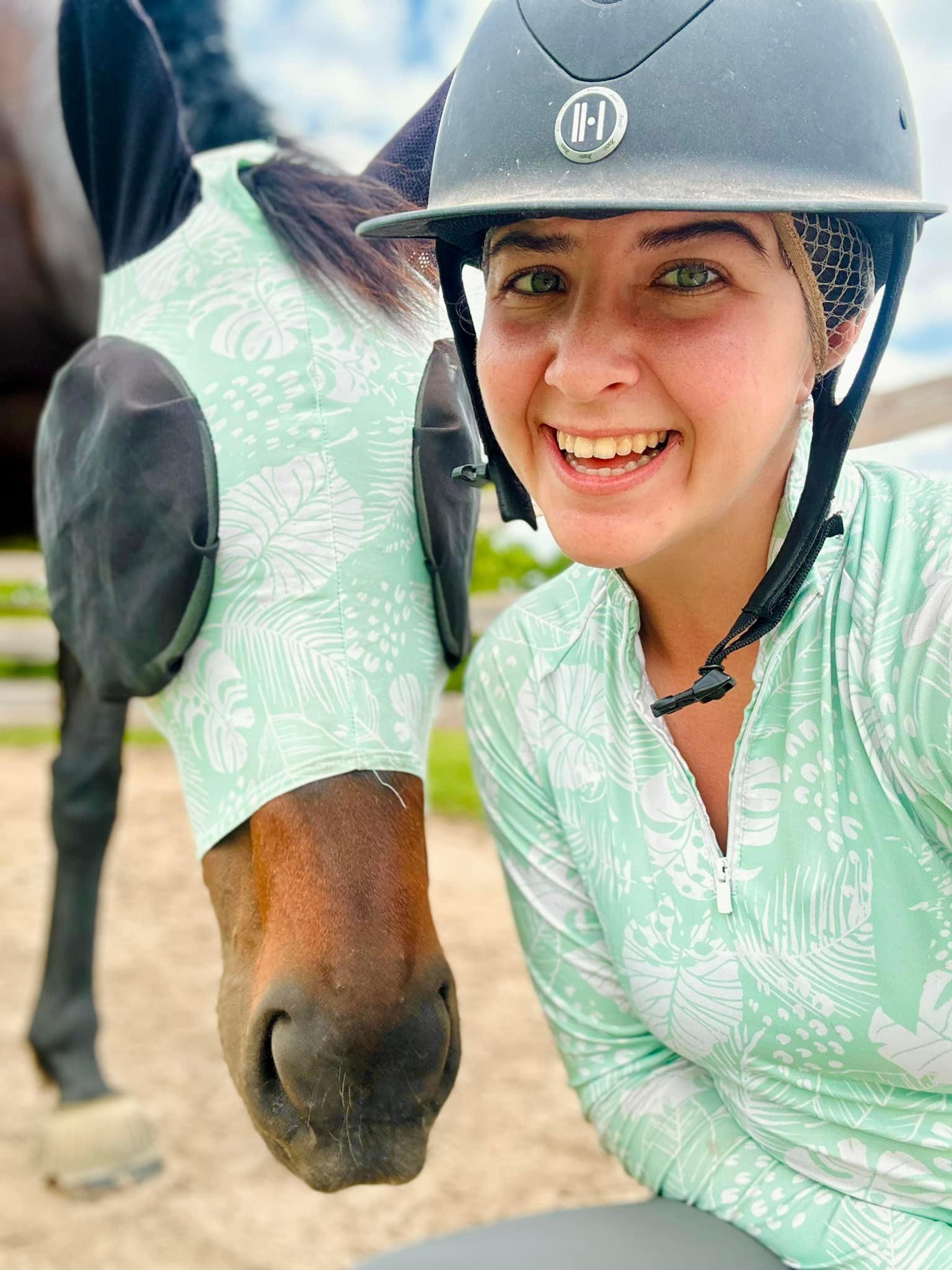
Your horse comes out of the stall tight. Ears up, eyes wide, already a half-size bigger than the horse you put away yesterday. You feel it the moment you swing your leg over — that electricity sitting just under the skin, that sense that something is coiled and waiting. And your first instinct is to pick up the reins.
That instinct is wrong. Not because contact is bad, but because the reins, in that moment, are not the tool the situation is calling for. Your body is.
This is what co-regulation actually means when you’re mounted on a hot horse: your nervous system becomes the information your horse reads to decide whether there is something to be afraid of. You can use that deliberately, or you can let it work against you. But you don’t get to opt out of it.
Why the Reins Make It Worse
Here’s what happens when you reach for more rein on a tense horse: your shoulders round forward, your elbows lock, your core grips, and your breathing goes shallow. You are now, in the language your horse speaks fluently, broadcasting the physiological signature of a predator that has found something. Your horse does not know you’re trying to be in control. Your horse knows that the presence on their back just sent a threat signal.
The rein pressure adds to that. A horse whose neck is already elevated and rigid does not become softer when they meet resistance. They meet resistance with resistance. It’s not stubbornness. It’s physics, and it’s nervous-system reflex.
What you’re looking for — throughness, rhythm, a horse that comes back down — lives behind the mouth, not in it. It lives in the hindquarters, the back, the ribcage. And you can only access those places through your body.
What Your Body Can Actually Do
Start with your exhale. Not a dramatic breath. A quiet, deliberate exhale that is longer than the inhale. This is not a relaxation cliché — it’s parasympathetic activation. The exhale engages the vagus nerve in a way that the inhale doesn’t, and it begins to shift your own nervous system state within a few seconds. Your horse will feel the change in your ribcage before you feel it yourself.
Soften your hip flexors. A tense horse almost always has a rider sitting with braced hip flexors — pelvis tilted, seat bones driving, lower back rigid. When your hip flexors are locked, you cannot follow the horse’s movement. You become a weight that is pushing rather than absorbing, and the horse’s back tightens in response. The fix is not to go floppy. It’s to let the front of your hip crease — to allow the joint to close and open with the stride rather than fight it. It is a release, not a collapse.
Match their rhythm, then slow yours. This is one of the most underused tools in riding: you have a rhythm in your body that the horse is partially tracking. When you’re on a hot horse, the tendency is to speed up your aids — quicker half-halts, more frequent leg, busier hands. All of that tells the horse that things are moving fast because things are urgent. Instead, find the rhythm of the walk and make your body slower than it wants to be. Breathe at a count of four. Let your posting rhythm drop one beat. You are not slowing the horse through pressure — you’re offering a slower frequency, and horses, given the right conditions, will start to download it.
Release the back of your knee. This is a back door that most riders don’t know exists. Gripping the thigh — which happens reflexively on a tense horse — usually starts as grip behind the knee joint. When you soften that specific spot, the thigh follows, the hip opens, and suddenly your seat is available to the horse again. Try it. It takes two seconds and costs nothing.
The Warm-Up Problem
One of the places this breaks down most consistently is in the first ten minutes of a ride. You’ve got a hot horse, you need to work, and the temptation is to either (a) push them forward into the energy and try to ride it out, or (b) hold them together until they settle. Neither works reliably, and both escalate.
What works is giving the horse something organized to do — something that asks for lateral movement and rhythmic thinking without demanding collection or throughness they’re not physically ready to give you. Shoulder-in at walk. Leg yields off the quarter line. Half-halts that are timed to the stride rather than pulled against momentum. And posting into the canter transition so the horse can’t jolt upward into it and spook themselves with their own energy.
If you’re not sure how to sequence all of that while managing your own nervous system at the same time, the free “Hot Horse Warm-Up” ride-along walks you through exactly this: how to warm up a sensitive or reactive horse without inadvertently triggering more reactivity with your leg, your weight, or the transition itself. It’s fourteen minutes you can play from the saddle, and it takes the decision-making off your plate on the days when your own nervous system doesn’t have bandwidth to spare.
When the Horse Is Hot Because You Are Hot
This is the conversation riders often want to skip, but it matters: sometimes the horse is hot because you brought it.
Not intentionally. Not because you’re a bad rider. Because you had a hard week, or the last ride ended badly, or you’ve been anticipating this horse’s reactivity since you pulled into the parking lot. Your nervous system was already running at a higher baseline before you ever touched the girth, and your horse met you there.
This is not a character flaw. It’s co-regulation working exactly as designed — your horse is reading your state and borrowing it. The question is just whether you want them to borrow the version of you that’s braced and scanning, or the version that’s breathing and organized.
The off-horse practices matter here more than most people give them credit for. What you do between rides — how you manage your own baseline arousal, whether you have reset tools that actually work — directly affects what you bring to the barn. I covered this in more depth in the post on the 90-second reset, and it applies directly to hot-horse days.
What Co-Regulation Actually Requires of You
It requires you to go first. That’s the whole job. Your horse is not going to regulate themselves and then wait for you to catch up. You are the one with the prefrontal cortex. You are the one who can make a deliberate choice. The horse is responding; you get to initiate.
Going first means:
- Exhaling before you react to a spook, before you make a correction, before you ask for anything.
- Softening your own body before you ask their body to soften.
- Slowing your aids before you ask for a slower rhythm.
- Releasing grip before you ask them to release tension.
None of this is passive. It is an active, skilled thing to regulate your own nervous system on a moving horse that is currently trying to convince you that something is wrong. It takes practice. It takes repetition. And it is, in my opinion, one of the most important things a rider can develop — because it transfers to every horse, every situation, and every moment when the reins aren’t the answer.
If you want to keep practicing this skill on your own, the ride-along library has audio lessons built specifically for moments like this — things you can play from the saddle so you’re not white-knuckling it alone.
If you want hands-on work on this — someone watching your body, calling out where you brace, and helping you build the physical habits that make co-regulation automatic — come ride with me. Clinics and lessons are available for riders at all levels, and nervous system work is woven into every session. Book at samanthabaer.com/contact.
And if you want to go deeper on the science and the practice — the physiology of how horses read riders, what threat response actually looks like in the saddle, and how to build a more regulated default — this is exactly the territory I dig into on The Elevated Equestrian podcast. The episodes in the Confidence & Nervous System lane are a good place to start, including a conversation on why “just relax” is bad advice and what to do instead. Find it at samanthabaer.com/podcast.