Dressage asks more of a horse’s back than almost any other discipline. You need it lifted, swinging, and soft for 45 minutes. Then you ask for it again tomorrow. When the back is tight, everything downstream suffers. The contact gets sticky, the hind leg stops reaching under, and the horse braces through transitions he could do in his sleep last month. You can’t fix that with gear. You can build a daily routine that supports his comfort before, during, and after the work. Here’s the Benefab setup I’d build for the dressage horse, starting with the pad.
This post contains affiliate links. If you shop through them I may earn a small commission at no extra cost to you — and you’ll get my reader benefits. I only feature gear I’d actually put on my own horses or wear for a full day in the saddle.
Quick Comparison
| Product | Price | Role in the Routine | Skip If |
|---|---|---|---|
| Therapeutic Dressage Pad | $119.95 | Daily under-saddle back comfort | Your saddle is already snug without a pad |
| Therapeutic All-Purpose Saddle Pad | $99.95 | Same job, close-contact or jump cut | You ride exclusively in a dressage saddle |
| Rejuvenate SmartHood | $179.95 | Neck and shoulder warmth before work | Your horse’s tension clearly starts behind the saddle, not in front of it |
| Rejuvenate SmartScrim | $349.95 | Full-body cool-out and recovery | You only ride two or three days a week |
Benefab Therapeutic Dressage Pad — $119.95
This is the product the whole routine is built around. The pad does its work for every minute your horse is under saddle, so it’s the first thing I’d buy.
The Therapeutic Dressage Pad uses Benefab’s woven therapeutic fabric, the same mineral-infused material that runs through the rest of their line. Its job is to support warmth and circulation through the area it covers. On a dressage horse, that area is the long muscles on either side of the spine. Those are the muscles you are asking to stretch, lift, and carry you through every half-halt.
The cut matters. A dressage saddle has a long, straight flap and sits the rider deeper. A jump-cut pad under it rides up short at the bottom and leaves the panel edges sitting on bare coat. The dressage cut gives you full coverage down the flap. The therapeutic fabric then sits under the whole saddle footprint instead of just part of it.
What I notice in use. The difference shows up most in the first ten minutes of the ride. That’s the window where a back-tight horse tells you whether today is going to be a fight. Many riders find their horses come through the back and reach for the contact a little sooner in the warmup. It won’t change your horse overnight. But a horse who starts the ride more comfortable often loosens up faster.
Fit and saddle-fit tips.
- Pull the pad up into the gullet before you girth. Pull it up again after you tighten. A pad that tents across the withers defeats the purpose and can create pressure where you least want it.
- Check saddle fit with the pad on. Any pad changes how the saddle sits. If your saddle is already on the narrow side, put your hand under the front of the panel with the pad in place before you commit. Benefab lists dimensions on the product page. Compare them against your current pad.
- Don’t stack it on top of a thick half pad. If you use a shimming half pad for a fit reason, talk to your saddle fitter about how to layer it. Don’t just pile everything on and hope.
- Wash it per the care instructions. Harsh detergents and fabric softener are not your friend with specialty fabrics.
Who it suits. The horse who is tight or guarded through the back in the first part of the ride. The horse coming back into regular work after time off. Any dressage horse whose rider wants every piece of gear to contribute something, not just keep the saddle clean.
Who should skip it. If your saddle doesn’t fit, no pad will save you. Get the fitter out first. And if you ride in a jump or close-contact saddle most days and only do dressage occasionally, buy the Therapeutic All-Purpose Saddle Pad instead. It does the same job, is $20 cheaper, and is cut for the saddle you actually use most. If your horse’s main issue is reacting to the girth and saddle going on at all, I covered that separately in my guide to Benefab for the cold-backed horse. That’s a different problem from the in-work tightness this post is about.
Rejuvenate SmartHood — $179.95
Here’s the part dressage riders tend to miss. The back doesn’t work in isolation. A horse who is tight through the base of the neck and shoulders can’t lengthen his topline, no matter what you put under the saddle. The neck is the front end of the same chain. If it’s locked, the back stays braced.
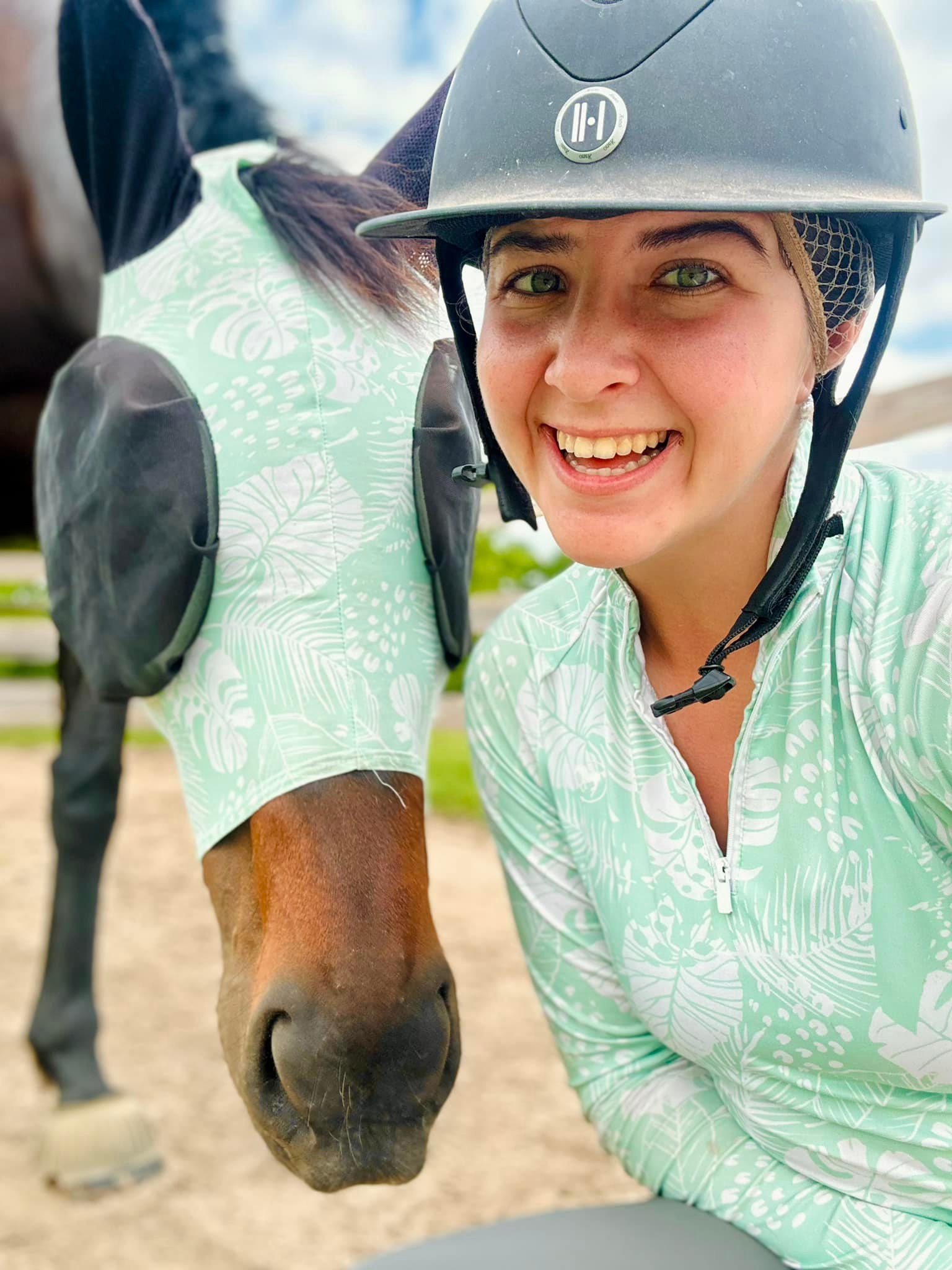
The Rejuvenate SmartHood covers the neck and shoulders with the same therapeutic fabric. I’d use it as a pre-ride piece. Put it on during grooming and tack-up, and leave it on for 20 to 30 minutes before you get on. That gives the front end a warm, settled start before you ask the horse to stretch down and out into the contact.
This is a good fit for fall. Mornings are cooler, clipped horses come out of the stall a little stiffer, and that first stretchy-trot circle can feel like riding a two-by-four. A horse whose neck and shoulders have had some warm-up time before the bridle goes on usually takes the contact with less argument.
Fit notes. The hood should lie smooth along the crest and over the shoulder without pulling at the throatlatch. Check the size chart on the product page. A warmblood with a big front end and a compact PRE can need different sizes even when they wear the same blanket. Introduce it in the cross-ties on a quiet day, not ten minutes before a lesson. Some horses need a session or two to accept something new over their face and neck.
Who it suits. The dressage horse who is braced in front of the saddle. You’ll see it in the horse who sucks back behind the contact or curls instead of stretching, or who feels short in the neck in the first part of every ride.
Who should skip it. If your horse is loose and easy in front and the tightness clearly sits behind the saddle, put that money toward the scrim instead. At $179.95 it’s a real purchase. Buy it for a specific reason, not because it looks nice in the tack room.
Ready to try the Therapeutic Dressage Pad and SmartHood together? Use my link for my reader benefits at Benefab → https://bit.ly/4uhqYoF
Rejuvenate SmartScrim — $349.95
The pad covers the ride and the hood covers the warmup. The Rejuvenate SmartScrim covers what happens after you get off. That’s the window most riders rush through, and it’s where a lot of next-day stiffness gets decided.
The SmartScrim is a full-body sheet in Benefab’s therapeutic fabric, built for cool-out and recovery. After a real dressage session, the back muscles have just worked hard and are about to stand still in a stall. Many riders put the scrim on after the horse is untacked and walked out. It supports warmth and circulation across the whole topline while he cools down.
I like it for this discipline because dressage horses rarely come back sweaty and blown the way an event horse does after a gallop. The effort is quieter. It’s isometric work: holding the back up, carrying weight behind, staying through. It’s easy to underestimate how much that took out of him. The scrim makes recovery a deliberate step instead of an afterthought.
Real-use observations. Leave it on through the cool-out walk and while he’s eating his post-ride hay. Many owners notice their horses settle and drop their heads during that time. The next-day test is what matters. Does the horse feel looser in the first ten minutes of tomorrow’s ride than he did before you added the scrim? That’s what you’re tracking.
Fit notes. Like any sheet, measure from the center of the chest to the point of the buttock and check against Benefab’s chart. It should cover the topline completely without hanging so long it slides back. Keep it clean and dry between uses.
Who it suits. The horse in consistent work five or six days a week, where recovery from one session feeds directly into the next. Horses in a build-up phase toward a test or a clinic.
Who should skip it. At $349.95, this is the biggest buy in the routine. If you ride a few days a week and your horse comes out loose and happy, it’s not your first purchase. Start with the pad and add the scrim when the workload justifies it.
How the Routine Actually Runs
Before: SmartHood on during grooming and tack-up. Twenty to thirty minutes is plenty.
During: Dressage Pad under the saddle, pulled up into the gullet. Spend a real warmup on long, low, forward work before you pick up the contact. The gear supports comfort. The warmup is still where the back actually loosens. If you’ve been drilling movements on a horse who never gets a proper stretch, why less is more in dressage training is worth reading before you buy anything.
After: Untack, walk out, SmartScrim on through cool-out and hay.
That’s the whole system: three pieces covering the three windows of the day. A horse who starts and finishes each ride comfortable through the back has a better shot at the swing and the reach judges reward. If points are what you’re after, I’ve written about scoring better on dressage tests without drilling your horse into the ground. I talk about the training side of the swinging back regularly on the podcast too.
The Bottom Line
If you buy one thing, buy the Therapeutic Dressage Pad. It works every ride and it’s cut for the saddle you actually use. Add the SmartHood if the tension starts in front of the saddle. Add the SmartScrim when your workload means today’s recovery shapes tomorrow’s ride. None of these replaces a good saddle fitter, a skilled bodyworker, or your vet when something feels truly off. They are consistent daily support for a horse whose job depends on his back.
Ready to try the Benefab Therapeutic Dressage Pad? Use my link for my reader benefits at Benefab → https://bit.ly/4uhqYoF