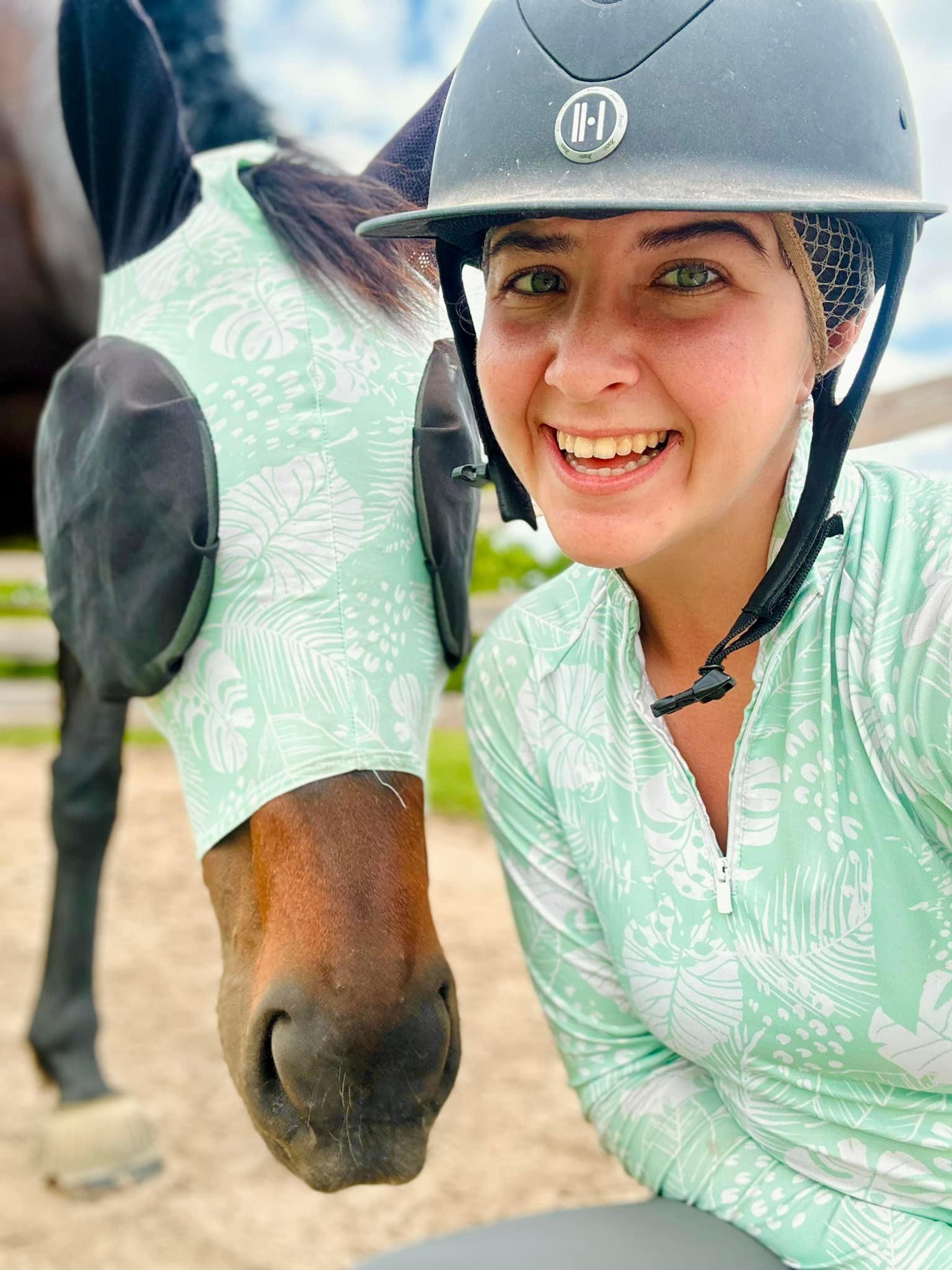
You’ve been told your horse is spooky. Maybe you’ve said it yourself. He shies at the mounting block shadow, pins when the wind picks up, comes off your leg like a firecracker when another horse canters past. Your trainer says “just ride him forward.” Your friend says “he needs more miles.”
But here’s what nobody’s asking: is your horse actually afraid? Or is he just running hot?
Because those are two completely different problems, and they don’t have the same solution.
The Difference Between Arousal and Fear
Arousal and fear both live in the sympathetic nervous system. Both cause elevated heart rate, muscle tension, heightened reactivity. From the outside — and sometimes from the saddle — they can look identical. This is why riders, trainers, and well-meaning barn friends conflate them constantly.
But the internal experience is different. And the behavior, when you know what you’re looking for, is different too.
Arousal is high activation without a specific threat. Think of a horse who’s been stall-bound for three days, or a young horse at his first event who can barely stand still at the start box. His nervous system is turned way up. He’s scanning, vibrating, ready to go. But he’s not convinced anything is actually out to get him. He’s excited — and his brain is still available, even if it doesn’t look like it.
Fear is arousal with a target. The horse has locked onto something specific — a tarp, a judge’s booth, the other side of the treeline — and his nervous system is telling him that thing is dangerous. His threat-detection pathways are active in a much more fixed, directional way. The dread is real to him, even if the threat is imaginary.
The distinction matters because arousal is fundamentally a management problem, while fear is a desensitization and confidence problem. Ride them the same way and you’ll make at least one of them worse.
What Arousal Actually Looks Like
The highly-aroused horse is usually easy to misread as spooky because he reacts to everything. He spooks at the barn cat, the flapping gate, the rider on the hill. But watch him carefully: his attention moves quickly. He lands, reassesses, and moves on. He’s not fixating. He’s scanning.
His reactions are often big — a sudden sideways leap, a jolt forward — but they’re brief. He comes back. He settles. He’s not convinced anything is hunting him; he’s just turned up so high that every stimulus trips the wire.
Other signs of pure arousal:
- Can’t stand still before work; needs to move
- Respects your aids once he’s moving but feels like a powder keg at the halt
- Gets more manageable as the ride goes on (rather than less)
- Energy drops significantly in familiar settings or with routine work
- Spooks at things he’s seen a hundred times, seemingly at random
This last one trips people up. “But he’s done this trail a dozen times — why is he spooking at that log today?” Because arousal level, not object recognition, is what’s driving the reaction. High arousal means the threshold for reaction is lower. The log isn’t new; today his nervous system is running hot.
What Fear Actually Looks Like
The truly fearful horse is different. His attention is sticky. He locks onto something and stays there — one ear pinned on the far end of the arena, head elevated, movement getting shorter and tighter as you approach. You can feel him mentally leave the building.
Where the aroused horse often gets better once you get him working, the fearful horse gets worse as you approach the trigger. His eye stays hard. He might slow down rather than speed up. He wants to stop, turn away, create distance.
Fear reactions also tend to be more explosive when they happen — because the horse has been suppressing a rising tide of threat response and then suddenly can’t anymore. The aroused horse spooks at the gate and comes back in three strides. The fearful horse hits that tarp and is genuinely, fully gone.
Signs of fear (rather than arousal):
- Fixed attention on a specific thing
- Shortening of stride or bracing as he approaches a trigger
- Sweat disproportionate to the workload
- No “coming back” — the reaction escalates rather than dissipates
- Avoidance is the priority, not forward movement
Some horses show both. An aroused horse has a lower fear threshold — meaning a horse who is already running high is more likely to tip into genuine fear when he hits a real trigger. This is why a horse can seem spooky in one environment and entirely manageable in another. It’s not inconsistency; it’s math.
Why This Matters for What You Do at the Start
If you’re getting on a horse who’s highly aroused — amped from a day off, fresh from a competition environment, fired up by the cold snap overnight — you need a warmup that brings the arousal level down without making the powder keg worse. This is not the moment to leg yield across the diagonal at rising trot and hope for the best.
The approach that works: shoulder-in at walk, leg yields to get him thinking laterally, half-halts that actually land, and moving into canter transitions without giving him a launchpad. The the “Hot Horse Warm-Up” ride-along walks through exactly this — how to warm up a sensitive or reactive horse without them running away from your leg, in fourteen minutes you can listen to in real time.
If you’re dealing with a fearful horse, the warmup protocol is different. You’re not trying to lower arousal through throughwork. You’re trying to build safety around a specific trigger, and that takes time, distance, and a different kind of patience.
The Rider’s Role in Both
Here’s the part that makes everyone uncomfortable: the rider’s nervous system is part of this equation.
An aroused horse is highly susceptible to co-regulation — meaning your body is either helping or hurting the situation. Tight hips, a braced core, a quick breath when you feel him surge: he reads all of it as confirmation that something is wrong. You become part of the problem.
I’ve written more about this in the context of what your body does before your brain catches up — you can find that thread on The Elevated Equestrian podcast, where we get into nervous system regulation from the rider’s side of the saddle.
With a fearful horse, your regulation matters just as much, but the intervention looks different. Staying soft and breathing when he locks onto the tarp at C isn’t passive. It’s information: this thing didn’t kill me; let’s reassess. But you also can’t override genuine fear with pressure. You can only be present enough that he has somewhere to come back to.
The Practical Test
If you’re not sure which you’re dealing with, here’s a rough field test.
Take your horse somewhere he’s shown reactive behavior. Get his arousal level down — a good 15-20 minute warmup on a familiar track, nothing demanding. Then bring him toward the thing he reacts to.
Does he come toward it more willingly as he warms through? Does his reaction to it get smaller as his overall tension drops? That’s arousal — once the system cools, the threshold rises, and suddenly the scary mounting block shadow is just a shadow.
Does his reaction to the specific thing stay the same or get worse, even as his overall body loosens? Does he seek distance from it specifically, even when he’s otherwise going well? That’s fear. The arousal level isn’t the issue; the association with the object is.
Treatment diverges here. Aroused horses need management of the baseline (work schedules, turnout, consistency, physical outlets) and a rider who can sit quietly through the reactivity without escalating it. Fearful horses need systematic exposure, positive association, and time — and a rider who knows when to retreat to a distance where the horse can breathe before moving closer again.
Calling a fearful horse “just hot” and riding him more aggressively into the trigger doesn’t build confidence. It floods him. And calling an aroused horse “scared” and tiptoeing around him doesn’t help either — it confirms to a horse who’s looking for leadership that yes, there probably is something to worry about.
Know Your Horse
The most useful thing you can do as a rider is get honest about which problem you actually have. Not which one is easier to admit to, not which one sounds better in the barn aisle — which one is actually happening in front of you.
Your horse is telling you. The question is whether you’re reading the signal.
If you want help working through this in real time — with your specific horse, your specific situation — I work through these distinctions in clinics and I’d be glad to take a look at what you’re dealing with. Reach out at /contact to ask about booking.
And if you want to keep building this on your own, the ride-along library is a good place to start between lessons.