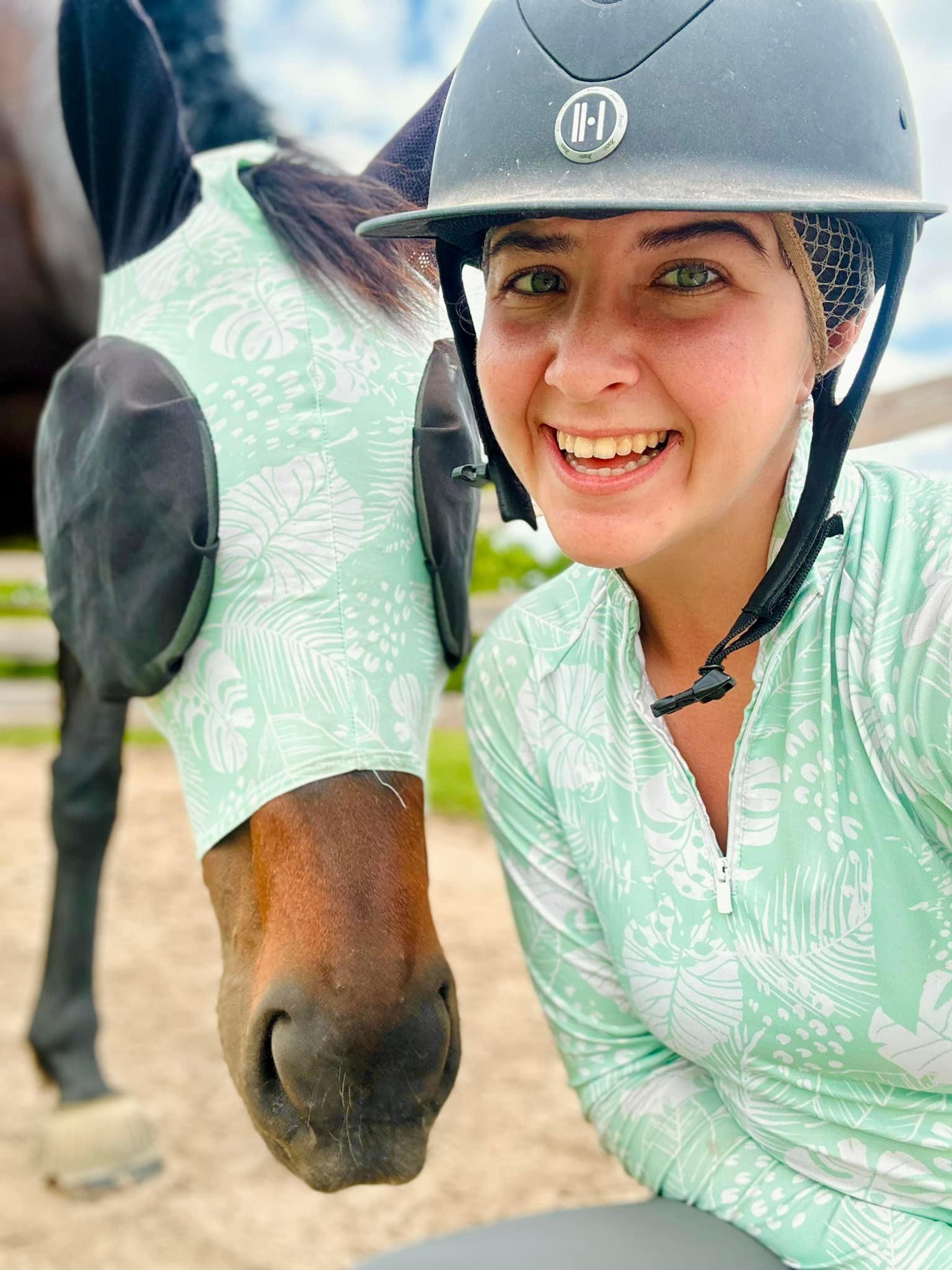
You drove to the barn running late, replaying a work call in your head, sweating through your shirt before you even got out of the car. Your horse takes one look at you and pins his ears. You’re already behind.
This is where most rides go wrong — before they even start.
The problem isn’t the horse. The problem is that you brought a activated, dysregulated nervous system into the barn and expected everything to smooth out once you got in the saddle. It almost never does. Your tension becomes his tension, and now you’re both managing each other instead of actually working.
What follows is the routine I use — and teach — to interrupt that cycle before it starts. It takes about ten minutes. It works.
Why “Just Breathe” Isn’t Enough
You’ve probably been told to take a deep breath before you ride. That’s not wrong, but it’s incomplete. A single breath doesn’t override a nervous system that’s been running hot for the last two hours. You need a sequence — something that moves your physiology from sympathetic activation (fight-or-flight) toward parasympathetic dominance (rest-and-regulate) before you ask your horse to trust you.
The good news: this doesn’t require a meditation cushion or twenty minutes of journaling. It requires understanding what actually signals safety to your nervous system, and doing those things in order.
Step One: Ground Yourself Before You Enter the Barn (2 minutes)
Stop at the barn entrance. Not inside — at the door or gate.
Stand with both feet flat on the ground, hip-width apart. Unlock your knees. Take three slow exhales, longer than the inhale. Exhale is the key — it’s the exhale that activates the vagus nerve and downregulates arousal. If you’re breathing in for four counts, breathe out for six or seven.
While you do this, look around. Not at your phone. Literally move your gaze — left, right, up, down. This is a nervous system reset borrowed from somatic work: slow visual scanning tells your brain there’s no immediate threat, and it helps exit the tunnel vision that stress creates.
Do this before you touch your horse. He will notice.
Step Two: Move Your Own Body First (3 minutes)
Your horse doesn’t get a proper warmup before you hop on and expect a clean shoulder-in. Neither should you.
Before you groom or tack up, do three minutes of movement that releases your own bracing patterns. Here’s what I do:
- Neck rolls, slow. Drop the chin to chest, roll right, back, left. Not fast. Feel where you’re holding.
- Thoracic rotation. Stand with feet hip-width, arms crossed over chest, rotate left and right from the mid-back. Not the lumbar. This is where most riders are chronically locked up.
- Hip circles. Hands on hips, big slow circles. If you feel clunking or resistance on one side, that asymmetry is going with you into the saddle.
- Three forward folds with a long exhale at the bottom. Not a stretch contest — just a reset.
This matters for a practical reason beyond nervous system regulation: if you show up to ride with your hip flexors shortened from sitting all day and your thoracic spine rotated left, those patterns become your horse’s problem within about thirty seconds of you sitting down.
Step Three: Groom with Intention, Not Efficiency (3 minutes)
Most riders groom like they’re on a timer. Pick feet, run brush, done. That’s fine if grooming is just about cleanliness.
But grooming is one of the best tools you have for regulating both of you. The contact, the rhythm, and the physical scan of your horse’s body all contribute to nervous system regulation — yours and his. It’s co-regulation happening in real time. (I’ve talked about co-regulation in depth on The Elevated Equestrian podcast if you want to go deeper on the physiology.)
Here’s how to use grooming as a tool:
- Start at the neck and shoulder, where most horses hold tension. Move slowly. Notice where he braces or leans into you.
- Match your breathing to a slow, rhythmic stroke. Not rushed. If you’re brushing fast, you’re still anxious.
- Watch his eye, his nostril, his lower lip. If he’s chewing and his eye is soft by the time you reach his hindquarters, you’ve done your job. If he’s still tight, that’s information — not a problem to push through.
A soft, well-fitted grooming tool makes a real difference here. If you’re fighting a stiff brush or a comb that snags, you lose the rhythm. I’ve got notes on the grooming kits and body brushes I actually use over on the gear reviews page.
Step Four: Set One Intention Before You Mount (2 minutes)
This step gets skipped constantly. Don’t skip it.
Before you put your foot in the stirrup, stand next to your horse and say — out loud or clearly in your mind — one thing you want to feel during this ride. Not accomplish. Feel.
Not “I want to get a confirmed flying change today.” That’s an outcome, and outcomes create pressure.
Try: “I want to feel connected through the contact.” Or: “I want to stay soft in my lower back when he spooks.” Or, on the hard days: “I want to finish this ride feeling better than I started.”
One intention. Specific. Sensation-based. This gives your prefrontal cortex something to work with instead of leaving your nervous system to scan for threats on its own.
If you’re coming back from a fall or a rough show, this step is especially important. I’ve written more about rebuilding confidence after a setback — the same principle applies: you’re not white-knuckling your way through. You’re giving your nervous system a road map.
What This Routine Is Not
It is not a magic trick. If your horse is genuinely in pain, if there’s a real safety issue, if you’re dealing with a horse who needs a veterinary workup — no breathing routine fixes that. This routine addresses what it addresses: your physiological state going into the ride.
It’s also not precious. On a busy morning when you have six horses to ride and a student at noon, you compress it. Three breaths at the gate, one minute of thoracic rotation, eyes on your horse during grooming. That’s still more than nothing.
The goal is a new default. Instead of arriving dysregulated and hoping the ride sorts you out, you make settling before the ride the standard. Your horse will tell you within about two weeks whether it’s working.
The Gear Angle
Two things I use in this routine that are worth mentioning: a good-quality body brush that gives you real contact without dragging (not a synthetic paddle brush) and a helmet that doesn’t make you wince every time you mount — because if tacking up is physically uncomfortable, that friction compounds anxiety. Both are categories I cover in my gear reviews if you’re looking for specifics.
Your nervous system is not a liability. It’s information. Learn to read it, manage it before the ride, and you stop asking your horse to carry the weight of a brain that hasn’t landed yet.
Ten minutes. Every ride. Start tomorrow.