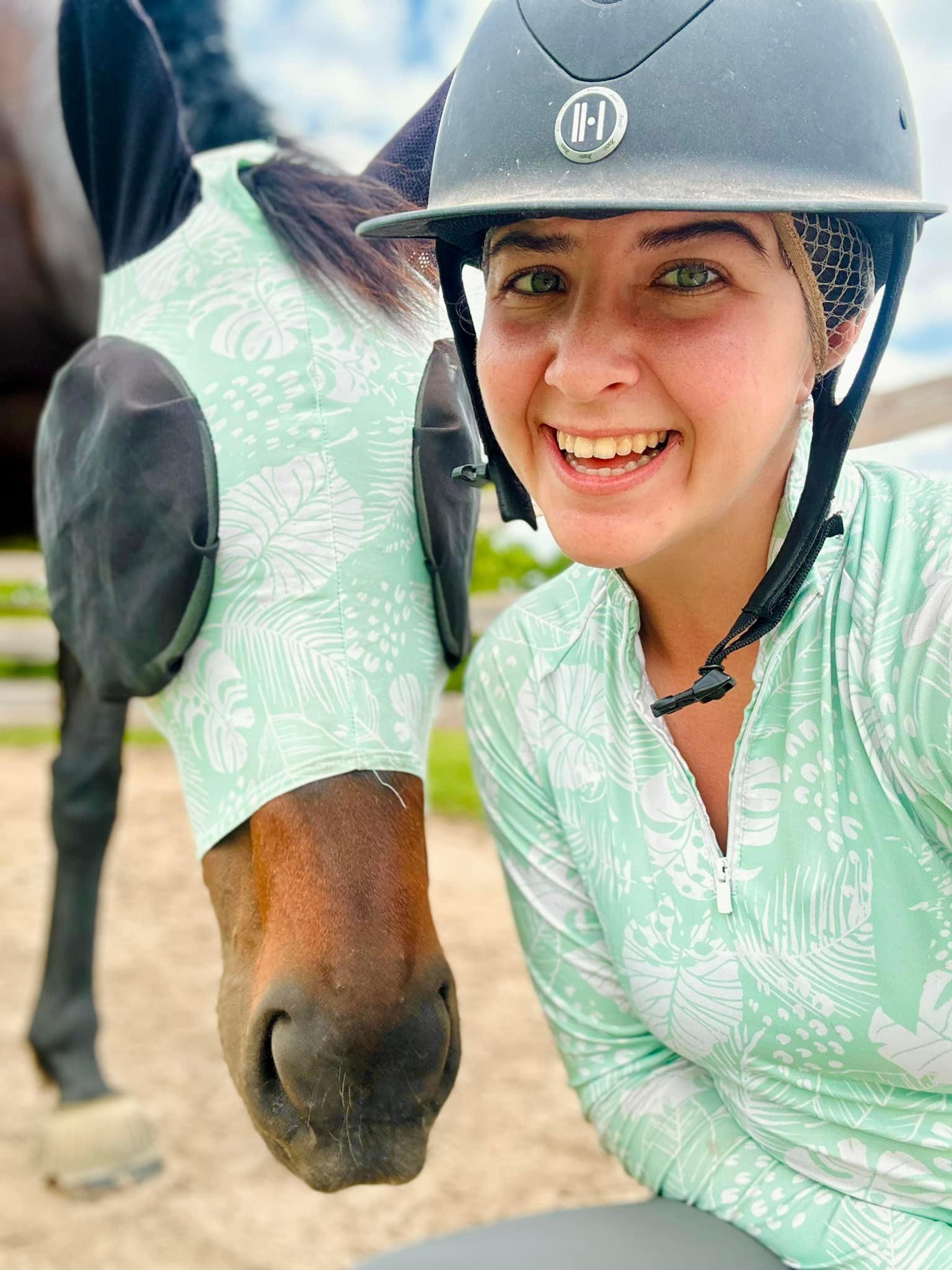
It is June in South Carolina and I am doing three to four rides a day in genuine heat. Every piece of tack on that horse gets evaluated differently in summer than it does in March. Pads especially. The question I am getting right now, more than almost any other gear question, is some version of: “Is sheepskin going to cook my horse’s back?” or “Is the memory foam going to hold heat?” Both concerns are reasonable. Neither is as simple as it sounds, and the honest answer depends less on the material and more on your horse, your riding volume, and what problem you are actually trying to solve. Here is how I think about it.
This post contains affiliate links. If you shop through them I may earn a small commission at no extra cost to you — and you’ll get my reader discount. I only feature gear I’d actually put on my own horses or wear for a full day in the saddle.
The Quick Comparison Before We Go Deeper
| Classic Jump Memory Foam Half Pad | Classic Jump Sheepskin Memory Foam Half Pad | |
|---|---|---|
| Price | from $125 | from $299 |
| Construction | Memory foam pockets, fabric top | Memory foam pockets, natural sheepskin top |
| Best for | Pressure distribution, everyday schooling, budget-conscious buyer | Premium comfort, friction-sensitive skin, horses prone to rubs |
| Breathability | Good — lower bulk, less insulation | Very good — natural sheepskin wicks and dissipates heat better than most synthetics |
| Hot-weather verdict | Strong everyday pick | Worth the price if your horse warrants it |
| Dressage version | Classic Dressage Memory Foam Half Pad | Classic Dressage Sheepskin Memory Foam Half Pad |
The short version: sheepskin is not your enemy in summer. Memory foam is not a heat trap. Both can work in hot weather. The smarter question is what your horse actually needs under the saddle and whether the price difference is justified by your situation.
The Memory Foam Half Pad: The Workhorse Pick
The Classic Jump Memory Foam Half Pad is where I send most people who are shopping for their first quality half pad, and it remains my most-recommended everyday schooling pad for summer for one simple reason: it does its job without adding bulk or heat in the places that would cost you.
The memory foam sits in pockets across the panel contact area and distributes pressure evenly across the horse’s back. That is the core function. It is not a corrective pad — it will not fix asymmetry or compensate for a saddle that does not fit — but for a horse whose saddle fits reasonably well and who needs even contact and cushion without shimming, this pad is genuinely hard to beat at its price point.
The breathability question answered directly. The memory foam itself does not breathe the way sheepskin does. It is a denser material. What it does not do, however, is trap significant heat against the horse’s back in the way a thick quilted cotton pad does. The fabric top layer on these pads is sweat-wicking and thin. The pad sits relatively close to the horse. The overall thermal footprint is lower than a padded quilted half pad, which is the thing riders are usually worried about when they ask whether half pads are “too much” in summer.
The dressage version — the Classic Dressage Memory Foam Half Pad — has the added benefit of a profile that keeps leg position clean. It is thin enough that it does not push your leg forward or alter the saddle balance significantly, which matters in a discipline where any shift in panel contact or flap clearance is immediately noticeable.
Who this is right for. A horse with a reasonably fitting saddle, a rider doing consistent volume through the summer months, anyone who needs even pressure distribution without the corrective complexity of shimming, and anyone working within a budget that makes $299 feel like a significant jump for a pad upgrade. At from $125, this pad punches well above its price.
Who should look at something else. If your horse has sensitive skin, tends to develop rubs under the saddle, or has a history of friction-related issues, the memory foam fabric top is functional but not specifically designed to reduce friction or provide the skin-level cushion that sheepskin does. That horse needs the next option.
The Sheepskin Memory Foam Half Pad: The Premium Summer Case
Here is where I expect to get pushback, because the instinct is to assume sheepskin equals heat equals bad idea in July. That instinct is wrong, and it is worth understanding why.
Natural sheepskin is a thermoregulating fiber. It wicks moisture away from the horse’s skin, it does not trap sweat against the back the way synthetic materials can, and it dissipates heat rather than insulating it the way a closed-cell foam or a thick synthetic pad does. The reason sheepskin is used year-round by professionals — including riders in genuinely hot climates — is that it manages the microclimate at the skin level better than most synthetics, in both directions. It is warmer than nothing in winter and cooler against the skin than a comparable synthetic in summer, specifically because of moisture management.
The Classic Jump Sheepskin Memory Foam Half Pad combines that sheepskin surface with the same memory foam pressure distribution that makes the standard pad effective. You are getting two things: the biomechanical benefit of even contact and cushion, and the skin-level benefit of a natural fiber that keeps the horse’s back more comfortable across a longer ride.
At $299, this is a meaningful investment. The question to ask honestly is whether your horse earns it.
The cases where this pad is the correct answer, not the luxury answer:
A horse with a history of rubs, white hairs, or saddle sores is the clearest case. Friction at the skin level accumulates over a summer of daily riding, and a sheepskin top layer reduces that friction more effectively than a synthetic top does. For horses who have already shown you what repeated contact does to their skin, the $174 difference between this pad and the memory foam version is cheap compared to the management cost of a back problem.
A horse who is visibly reactive to saddle pressure — a horse who pins ears at girthing, who hollows at saddle placement, or who has a history of tension under saddle that does not have a clear musculoskeletal explanation — is a second strong case. Sheepskin conforms to the horse’s back in a different way than foam does. It molds. It gives. Some horses that have had a difficult relationship with saddle contact settle measurably with a good sheepskin surface underneath.
A horse doing extended work — longer conditioning rides, full competition days, multi-class show schedules — benefits from a surface that manages skin condition over time rather than just at the start of a ride. Memory foam distributes pressure effectively from minute one. Sheepskin distributes and manages the skin environment across two hours or more.
For dressage riders, the Classic Dressage Sheepskin Memory Foam Half Pad carries the same reasoning into a cut that works for longer panels and dressage saddle geometry.
The honest limits of sheepskin in summer. Sheepskin requires more maintenance than a fabric-top pad. It needs to dry completely between rides — a pad that stays damp in a humid barn environment is a different problem than a pad that got sweated through in a 45-minute school. If you are doing back-to-back rides on the same horse with a short turnaround, you need two pads or a faster-drying option. The memory foam version dries faster and requires less handling. For barn managers or working riders with tight schedules, that practical difference matters.
Ready to try the Ogilvy Sheepskin Memory Foam Half Pad? Use my link for reader benefits at Ogilvy Equestrian → https://ogilvyequestrian.com/samanthabaer
The Under-Pad Question: Baby Pad vs. Profile Pad Underneath
Whichever half pad you land on, what goes under it matters in summer. The Classic Jump Baby Pad at $65 is a sweat-wicking, replaceable under-pad that sits between the saddle and the half pad, protects the half pad from the majority of the sweat load, and is the piece you actually wash every day. It is thin, it dries fast, and it keeps your half pad in better condition for longer. For summer riding volume, I consider it non-optional.
If your horse needs wither clearance — a high wither, a horse that bridges, or a saddle that tends to sit down at the pommel by the end of a ride — the Classic Jump Profile Pad at $85 is worth looking at before you decide whether a half pad is what you actually need. The profile pad provides clearance and back-shape conformity without adding the pressure-distribution layer of a half pad. Some horses need clearance more than cushion, and putting a half pad over a saddle that is already creating wither pressure is not the fix. Get the clearance sorted first. I talked through the logic of this on the podcast when we got into saddle fit sequencing — clearance before cushion is the principle.
If you are working with a saddle that fits 80 percent correctly and the remaining 20 percent is unevenness rather than overall fit, the shimming conversation belongs in a separate post. But know that neither the memory foam nor the sheepskin memory foam pad includes shim pockets. For asymmetry correction, that is the Classic Jump Shimmable Half Pad conversation.
The Decision Framework: Which One Do You Actually Need
Start here: does your horse have friction-sensitive skin, a history of rubs, or a pattern of back reactivity that suggests skin-level discomfort rather than structural fit problems?
If yes, the Sheepskin Memory Foam Half Pad is the right pad. The price is real but it is not excess — it is the right tool for a horse whose skin tells you it matters.
If no, and your horse has a reasonably fitting saddle and needs reliable pressure distribution for summer schooling, the Memory Foam Half Pad is the honest answer. It does the job. It holds up. It is not a compromise product at its price point.
Both pads are designed to be used with a baby pad underneath. Budget for that too — $65 for the baby pad and you have a complete, functional system that is going to serve you through the summer and well beyond it.
Summer heat is not a reason to ride in less pad than your horse needs. It is a reason to choose the right pad for what your horse’s back is asking you for. Those are different questions, and the answer to the second one is worth taking seriously.
Ready to shop the full Ogilvy half pad range? Use my link for reader benefits at Ogilvy Equestrian → https://ogilvyequestrian.com/samanthabaer