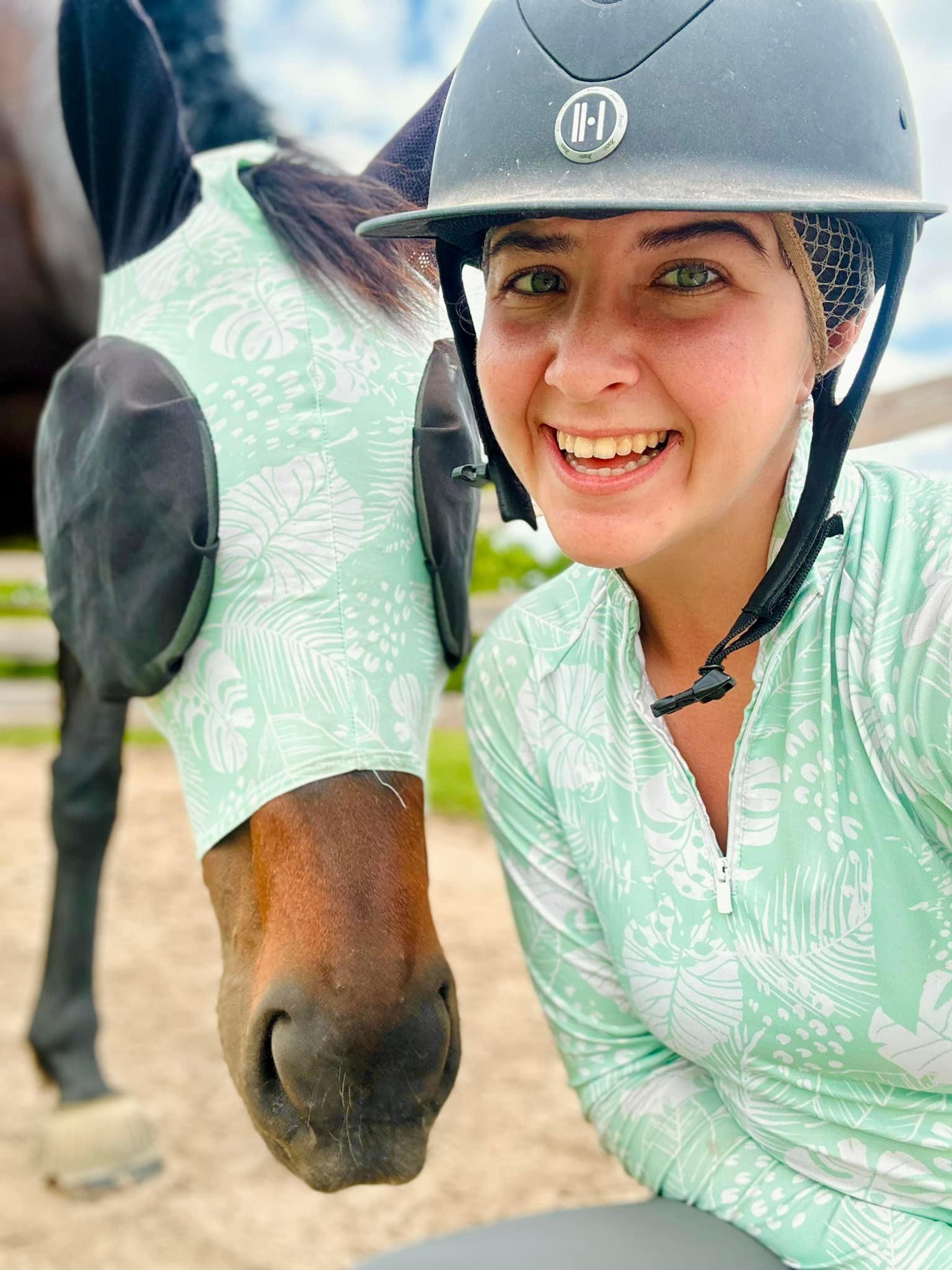
By 9 a.m. in Aiken in late May, the humidity is already doing something unpleasant to your lungs. By 11, the sand in the arena reflects heat back up at both of you. By 2 in the afternoon, you and your horse are just suffering together, and nobody’s learning anything useful.
If you’re still building your schedule around when it’s convenient for you rather than when it’s survivable for your horse, this is your nudge to rethink it — before July gets here and makes the choice for you.
Here’s what I’ve worked out over several summers training in Aiken, SC, and what actually holds up when the heat settles in for real.
The Only Window That Matters: 5:30 to 8:30 a.m.
I know. Nobody wants to hear this. But that three-hour window in the early morning is genuinely where all the quality work happens from June through September in the South.
By 5:30 a.m. in Aiken, you have usable light and temperatures that are at least 10 to 15 degrees cooler than midday. Humidity is still high — it’s always high — but there’s usually a faint movement of air that disappears completely once the sun gets overhead. Your horse’s thermoregulatory system is working in a reasonable range. Your own is too.
What this means practically:
- Hack or warm-up by 5:45. You want to be in productive work by 6:00 or 6:15, not still picking feet at 6:30.
- Cap your schooling session at 45 minutes of active work. Not 45 minutes of clock time — 45 minutes of actual working trot, lateral work, transitions, whatever you’re training. Walk breaks count as recovery, not work time.
- Cool-out before 8:30 so your horse is washed, scraping, and headed toward his fan before the heat ramps up hard.
If this sounds extreme, consider that professional riders in Florida, Texas, and the Southeast have been doing this for decades. It’s not a hack. It’s just how summer works.
Finding Shade in Aiken: What Actually Helps
The good news about Aiken specifically is that the tree canopy here is genuinely exceptional compared to most horse country. The pine forests and old hardwoods throughout the Hitchcock Woods, the horse district neighborhoods, and properties along the trails offer shade that can drop the apparent temperature by several degrees.
Hitchcock Woods is the obvious answer for trail riding and conditioning, and it’s one of the reasons Aiken is such an extraordinary place to be an equestrian. The 2,100-acre urban forest has enough canopy cover that a slow conditioning ride through the trails in the morning stays reasonably cool even when it’s warm outside. If you’re doing conditioning work in summer, do it in the Woods, not in your open arena.
For flatwork, your best bet is shade from structures rather than trees — a covered arena, a barn overhang, or a tree line on the west side of your ring that blocks late-morning sun. If your main arena is fully exposed, be honest about what that costs your horse in energy and stress, and consider whether an abbreviated session under a covered barn aisle does more good than a full session in an exposed arena.
One practical thing I do: I’ll move my cavaletti or pole work under the barn overhang in summer for ground-pole sessions. It’s not glamorous, but it keeps both of us out of direct sun during the part of training that doesn’t require a full arena.
What to Actually School (And What to Drop) in the Heat
This is where people get into trouble. They keep trying to train the same program they run in October, just at 7 a.m. instead of 10 a.m., and wonder why their horse feels flat or why they’re not making progress.
Heat changes what your horse can give you. It doesn’t mean you can’t train — it means you have to be selective.
What holds up well in summer heat:
- Transitions. Short, sharp, frequent transitions don’t require sustained cardiovascular effort, but they build throughness and responsiveness. A horse who’s tired from heat can still do a clean walk-to-canter transition if you ask correctly.
- Lateral work at walk. Leg yield, shoulder-in, haunches-in at walk — these build body awareness and suppleness without taxing the cardiovascular system. For a hypermobile horse especially, this kind of slow, controlled work is often more productive than a long trot set anyway.
- Short canter sets with real walk breaks. Three minutes on, five minutes off. Stop trying to sustain the canter for ten straight minutes in July.
- In-hand and groundwork. June through August is when I actually get ahead on in-hand work because it’s productive, low-impact, and I can do it in the barn aisle if I need to.
What to cut or dramatically shorten:
- Long trot sets for fitness. Fitness conditioning in summer should happen in the Woods at appropriate paces, not as endless arena trot.
- Collected work that requires significant muscular effort. If your horse is struggling to maintain temperature, his muscles are working overtime on cooling. Don’t add more load on top of that.
- Any training that requires real mental focus from either of you after 9 a.m. The heat compromises cognition — yours and your horse’s. If you missed your window, shorten the session rather than push through.
Scheduling the Rest of Your Day Around the Heat
Summer in Aiken means restructuring your whole barn day, not just your ride time.
My general template:
- 5:30 a.m. — Feed, check horses, start tacking up
- 6:00–7:30 a.m. — Ride one to two horses
- 7:30–9:00 a.m. — Cool-outs, baths, rehydration, turnout decisions
- 9:00 a.m.–4:00 p.m. — Stalls, hand-grazing, in-hand work only if needed, stay out of direct sun
- 4:30–6:30 p.m. — Second session if needed, usually light hacking or ground work only
If I have a horse who needs more miles, I’m doing it in the morning, period. Afternoon rides in June, July, and August in Aiken are for walking, hand-grazing, and relationship maintenance. Not real training.
A Note on Nervous-System Load in the Heat
This is something I talk about on The Elevated Equestrian podcast fairly regularly, and it applies directly to summer training: heat is a stressor. It activates the sympathetic nervous system in both horse and rider. If your horse already runs a little hot emotionally — reactive, tight through the back, quick to escalate — expect that to amplify in the summer.
This isn’t a behavior problem. It’s physiology. A horse whose nervous system is already under thermal stress has less capacity to handle training pressure. That means you need to reduce the cognitive and emotional demand of your sessions, not increase it, to get a positive training response.
The horses who seem to fall apart in summer are often the ones whose riders keep pushing the same program without accounting for this. Back off the complexity. Do simple, predictable work. Let your horse feel successful. You’ll come out the other side of summer with a more solid horse than if you’d ground through it.
The Bottom Line for Aiken Riders
Aiken summers are real. They are hot, they are humid, and they don’t care about your show schedule or your training timeline. The riders who manage them well are the ones who restructure their entire day around the heat rather than fighting it.
Get up early. Find the shade. Shorten your sessions. Cut the complexity. Do the slow work your horse actually needs.
If you want to talk through how to restructure your summer training program — especially if you’re working with a hypermobile horse, a horse with nervous-system sensitivities, or you’re just trying to get the most out of limited morning windows — I offer lessons and clinics here in Aiken and I’d love to help you build a plan that actually works for where you are and what you’ve got. Reach out at /contact and let’s figure out your summer.