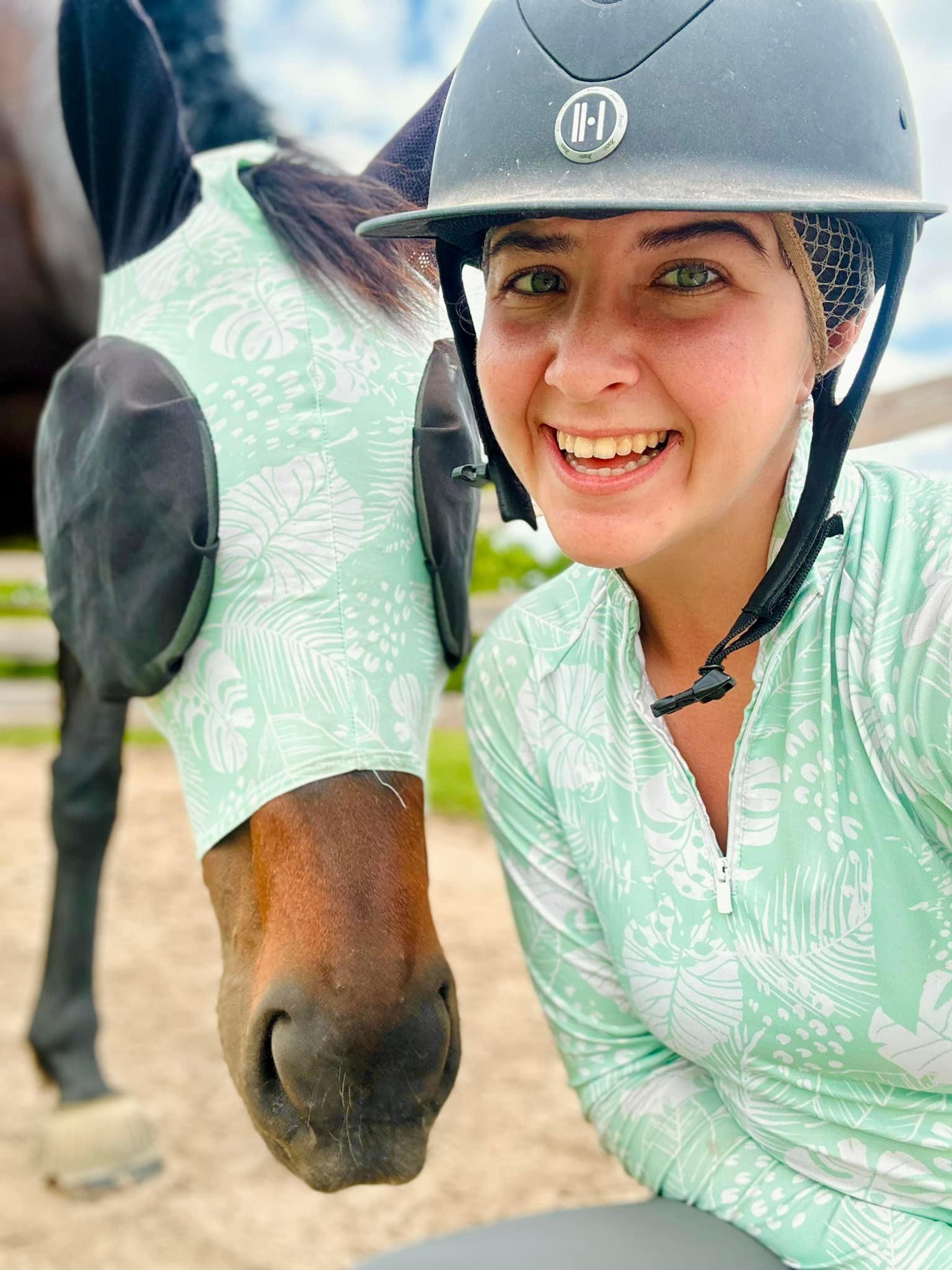
Poll tension is one of those things that is everywhere in the sport horse world and almost never talked about directly. We talk about the resistant horse, the horse that won’t bend left, the horse that throws his head when you pick up the reins, the horse that is a nightmare to bridle — and often, quietly sitting underneath all of it, is a tight, guarded poll. Once you know what to look for, you start seeing it constantly.
This post contains affiliate links. If you shop through them I may earn a small commission at no extra cost to you — and you’ll get my reader benefits. I only feature gear I’d actually put on my own horses or wear for a full day in the saddle.
What Poll Tension Actually Looks Like
The poll is the joint at the very top of the horse’s skull, where the head meets the atlas vertebra. It is the most mobile joint in the entire cervical spine, which means it is also one of the first places the horse communicates discomfort, guardedness, or bracing. It shows up in a lot of ways that riders tend to misread.
The most obvious one is head-tossing or ear-pinning when you reach for the bridle. If your horse consistently gets tight in the face the moment the crown piece goes over their ears, that is worth paying attention to. But poll tension also shows up more subtly: the horse that is perpetually above the bit despite correct contact, the horse that drifts counter to every bend you ask for, the horse that braces through transitions and never quite comes through the topline, the horse that feels locked between your hand and your leg like something upstream is refusing to yield.
I have a mare who presented as “just stiff to the left” for about two years before I started looking at her poll more carefully. Turns out the stiffness to the left was downstream of a habitual tension pattern at the poll that made it difficult for her to truly flex in either direction. The left was worse because she was already slightly right-dominant, but the root of the issue was at the very top.
In summer specifically, this becomes more common. Heat makes horses irritable, they move with less forward energy, their work often becomes heavier and more compressed, and horses that are already prone to tension through the poll tend to brace more in hot, sticky conditions. Worth having this conversation now, going into peak summer work.
What a Poll-Focused Recovery Routine Looks Like
Before we talk about tools, the routine itself matters. This is what I do with a horse I know is carrying tension through the poll — and it makes a real difference whether I have therapeutic support in hand or not.
First, I give them time at the halter with quiet, intentional pressure at the poll before I ever pick up the bridle. Not massage exactly, but a slow, sustained contact just behind the ears — letting them drop their head into it. Many horses will yawn, lick and chew, or audibly exhale within thirty to sixty seconds. That response tells you something.
Second, I do not rush bridling. I allow the crown piece to sit just behind the ears for a moment before I fasten the noseband. If they are bracing, I wait. Hurrying a tight-poll horse into the bridle just compounds the problem and sets the whole ride up with a braced, guarded horse.
Third, after work, I take the bridle off slowly and give the same behind-the-ear contact before putting them back on the halter. The post-work moment is the one most riders skip entirely. It is also the moment when the horse can learn to associate the poll area with release and comfort rather than just with the work being over.
That routine becomes significantly more effective when you add targeted therapeutic support to it.
The Smart Therapeutic Poll Pad: What It Is and How I Use It
The Smart Therapeutic Poll Pad ($39.95) is the tool I reach for first when I am working with a tight-poll horse. It sits between the crown piece of the halter and the poll itself, delivering the therapeutic warmth and far-infrared technology that Benefab uses across their entire line — but focused exactly where you need it for this particular pattern.
The fabric is the same responsive material Benefab uses throughout their product range: it works with the horse’s own body heat and reflects it back as far-infrared energy, which many owners notice encourages circulation and relaxation in the tissues it contacts. For the poll-tense horse, having something sitting warmly and gently at that joint during quiet standing time — before or after work — supports a softening response that you simply do not get from a standard nylon crown piece.
Here is how I use it practically: I put it on the halter during grooming and pre-ride prep. The horse wears it for fifteen to twenty minutes before I switch to the bridle. Many horses that initially brace when you approach their poll will visibly soften during that time — dropping the head, relaxing the jaw, blinking slowly. That is not a guarantee, and I want to be honest about that. Some horses are tense at the poll because of a management issue, a fit issue with the bridle, or a training gap that no therapeutic product will substitute for. But for the horse that holds tension as a habit pattern — the horse that is not actively uncomfortable but is simply braced as a default — this kind of targeted warmth before work makes a real difference in how they show up.
I also use it post-ride. If a horse has been working through a demanding school and you know they tend to brace through the contact, putting the poll pad on during cool-out gives the tissues at the top of the neck a chance to decompress and settle.
Fit note: the Smart Poll Pad fits over a standard halter crown piece. It is not a standalone piece — you are sliding it over your existing hardware. Most horse-sized halters work without issue. If your horse is particularly narrow through the poll, check the dimensions before ordering, but I have not had a fit issue with a standard-sized horse.
Ready to try the Smart Therapeutic Poll Pad? Use my link for my reader benefits at Benefab → https://bit.ly/4uhqYoF
The Therapeutic Poll Pad: Entry Point for the Same Routine
If you want to start with the basic version before committing to the Smart, the Therapeutic Poll Pad ($29.95) is the entry-level option and uses the same therapeutic fabric in a simpler construction. The ten-dollar difference between the two is worth understanding: the Smart version has additional technology built into the fabric that enhances the far-infrared output, while the base Therapeutic Poll Pad still delivers the warmth and circulation-support benefits but at a more straightforward level.
For a horse that is mildly tense — one that bridles without drama but feels blocked through the contact mid-ride — the Therapeutic Poll Pad is a reasonable starting point. For a horse with a consistent, well-established tension pattern, I would spend the extra ten dollars on the Smart version. You are building a habit with this routine, and the stronger tool gives you a clearer signal in the early weeks of whether or not the approach is working.
Layering In the SmartMask for the Full Head-and-Poll Picture
For horses where the tension lives not just at the poll but through the entire head — horses that are reactive around the face, sensitive about their ears, or who carry anxiety through the poll-to-jaw connection — the Rejuvenate SmartMask ($79.95) is worth adding to the routine.
The SmartMask covers the face and poll area in the same far-infrared fabric, and many horses that are anxious or tense in the face will genuinely settle when wearing it during quiet time in the stall or during cool-out. I have heard from riders who use it pre-show on horses that are normally difficult to manage in a busy warm-up environment — and while I want to be careful about overpromising anything here, the behavioral shift many people describe is consistent enough to take seriously.
It is not a substitute for training. A horse that is reactive around the face and poll needs correct, patient work on accepting contact and handling, full stop. But the SmartMask can make those training sessions feel more productive by taking some of the edge off before you even begin.
Fit consideration: sizing matters here more than with the poll pad. Benefab lists sizing guidance on the product page — measure before ordering. A mask that does not fit correctly will defeat the purpose and frustrate the horse.
Putting It Together: A Summer Poll-Routine Outline
This is the routine I would actually run, starting this month going into the heat of summer:
Pre-ride (15-20 min before bridling): Smart Therapeutic Poll Pad on the halter during grooming. Quiet, intentional contact behind the ears. Do not rush. Let them tell you when they have softened — watch the jaw, the eye, the exhale.
Bridling: Slow. Crown piece over the ears, pause, then fasten. If they are bracing, wait them out. Do not fight it.
Post-ride: Smart Poll Pad back on during cool-out if the school was demanding. If you have a horse that is reactive through the whole face, add the SmartMask here.
Weekly check-in: Are they softening faster before the bridle than they were a week ago? Are transitions coming through more easily? Is the head-tossing less frequent? Use these behavioral markers to gauge whether the routine is working.
You can also hear me talk through tension patterns in the sport horse and how they affect everything from contact quality to lateral work on the podcast — it comes up more than you might expect.
Poll tension is not dramatic, and it is not always obvious. But it is one of the most common things quietly limiting good horses and good riders from getting where they want to go together. A targeted routine — one that includes thermal support at exactly the right place — is a simple, low-barrier place to start.
The Smart Therapeutic Poll Pad is $39.95, it fits over any standard halter, and it is the kind of thing that becomes part of your daily routine so quickly you forget you were not doing it before.
Ready to build this into your routine? Use my link for my reader benefits at Benefab → https://bit.ly/4uhqYoF